
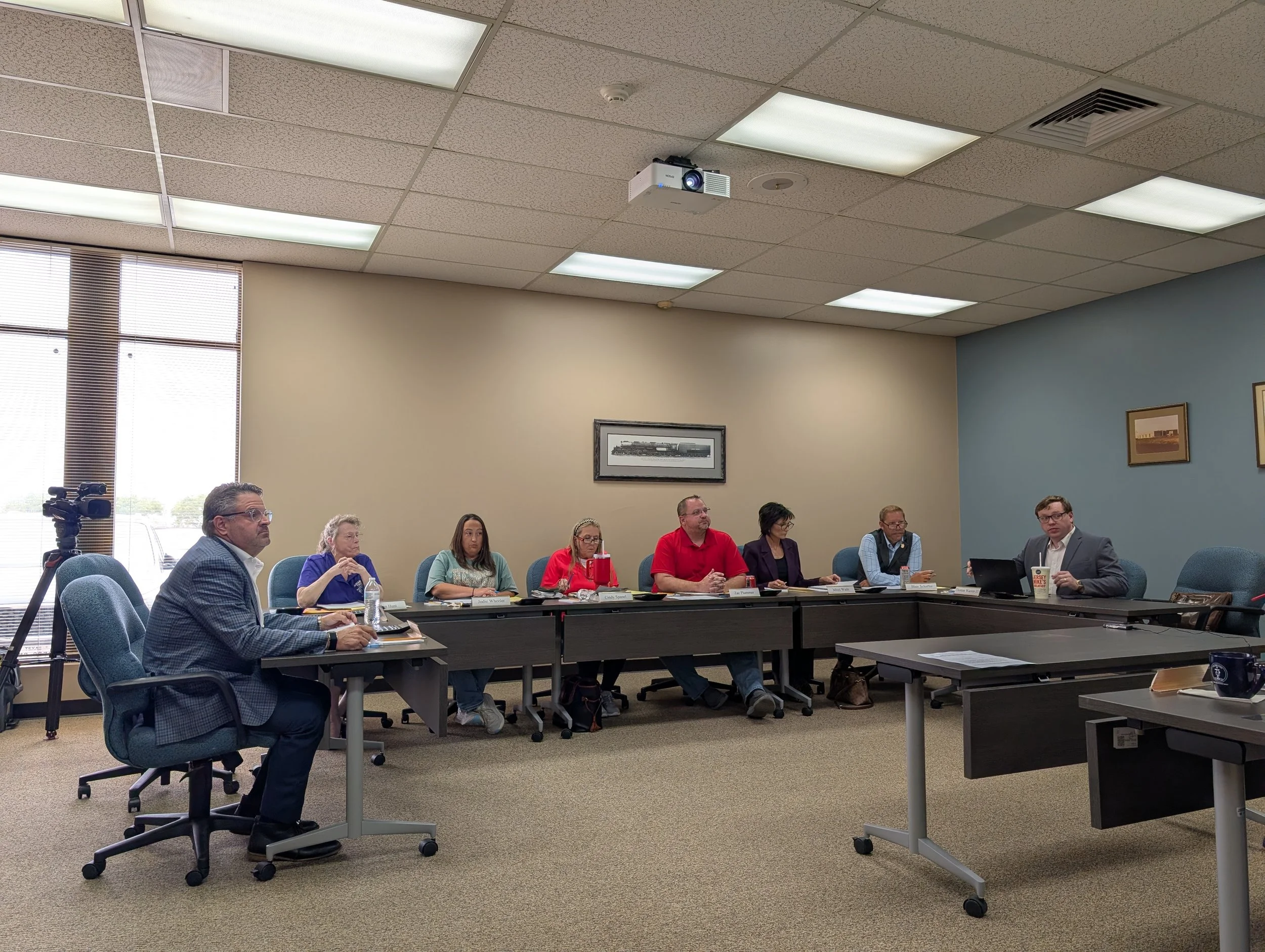
Potter County Appraisal District Board of Directors | Photo by The Amarillo Pioneer
The future of the Potter-Randall Appraisal District’s governance remains up in the air as the two governing boards met separately on Tuesday. Both boards started the process to retain outside counsel ahead of an anticipated renegotiation of the district’s 1987 governing contract.
That contract, as we have previously reported, granted most of the district’s power to Randall County’s Board of Directors, with the powers of the Potter County board mostly limited to ratifying Randall County board’s selection of the chief appraiser and appointing the Potter County Appraisal Review Board.
The Potter-Randall Appraisal District is unique in Texas, being the only appraisal district office serving two counties. Typically, appraisal districts serve one county and are governed by a single Board of Directors, with the board setting overall policy for the office (though they do not have direct control over actual property appraisals).
By custom, most decisions at PRAD have been made with input and votes from both boards, though disagreements tended to be few and far between. Recently, however, several major changes and controversies have brought new attention to the actual governing contract.
One of the changes which has altered the dynamics of the arrangement was an increase in the size of both boards. Historically, the boards had each consisted of five members who were elected by the taxing districts from each county, with each county’s Tax Assessor-Collector serving as a non-voting member. In 2023, the state legislature added three new seats to each board elected by the general public. The legislature also made the Tax Assessor-Collector a vote.
Along with this structural change, two recent controversies have caused tension. In recent meetings, Potter County Tax Assessor-Collector Thomas Warren III has advocated for broadcasting the appraisal district board meetings. While a majority of both boards have supported the idea, there has been some pushback. This pushback against transparency has prompted some in the community to put the PRAD board under more of a microscope.
Additionally, it was revealed earlier this year that a major value exemption had not been included in the 2025 certified tax roll, which caused property owned by Tyson to be significantly overvalued. The ultimate effect has led to a large budget shortfall for several taxing units in Potter County. While this error has primarily affected Potter County, the Potter County Board of Directors, under the current contract, has little power on its own to respond to such issues.
While the Randall County Board of Directors expressed some skepticism about the need to renegotiate the contract, they ultimately chose to move forward with seeking outside counsel. The Potter board, on the other hand, seemed to have unanimous consensus on the need to renegotiate.
The debate on the Potter County side had less to do with whether or not the contract needed rewritten and more to do with strategy. Four board members expressed some support for triggering “Section 12,” which would give the Randall County board a six-month notice that the Potter County board intends to terminate the contract. Board members Thomas Warren III, Tom Warren II, Chip Hunt, and newly-appointed member Craig Gualtiere each, to varying degrees, argued it would give leverage in negotiations while stressing that they felt it would help reach a fair deal. Board Chair Zac Plummer, along with board members Cindy Spanel, Blair Schaffer, Mitzi Wade, and Jodie Wheeler urged caution and worried that, in the event a deal could not be reached, Potter County would have to be ready to form its own separate appraisal office. It was noted by Chief Appraiser Jeffrey Dagley, however, that in the event Potter County were forced to form its own appraisal district, Randall County would have to buy out Potter County’s share of the district’s assets, including its land, building, and supplies.
While there was disagreement regarding strategy, they did ultimately decide to move forward with seeking outside counsel, opting to form a four-member subcommittee of Zac Plummer, Craig Gualtiere, Chip Hunt, and Thomas Warren III to search for a lawyer.