
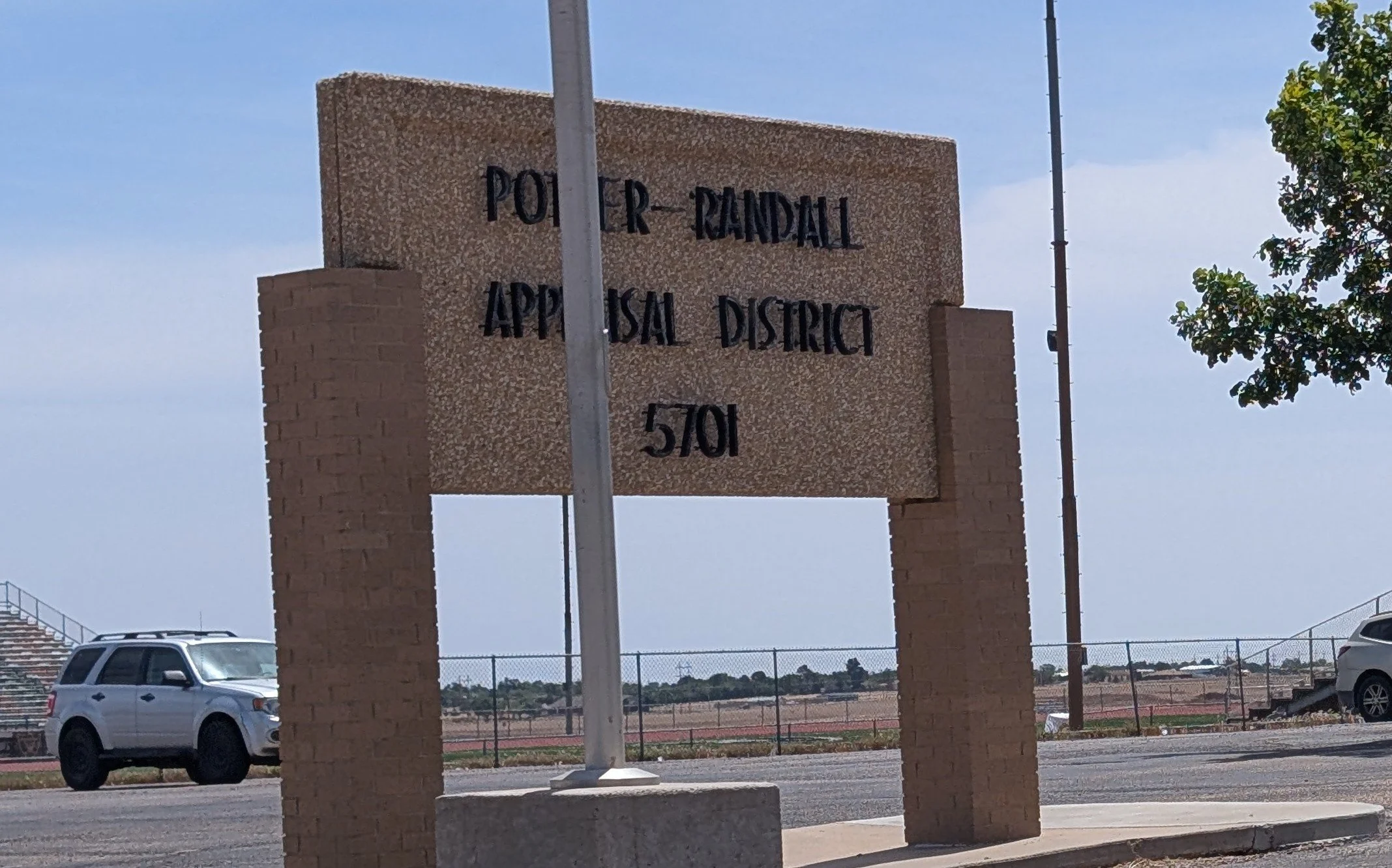
Photo by Pioneer Staff
By Nick Self
Ahead of Friday’s meeting of the Potter County Appraisal District Board of Directors, a newly released legal memorandum detailing state laws governing interlocal agreements makes one point explicitly clear: despite decades of joint operations, Potter and Randall counties cannot legally merge into a single entity.
The document, which was attached to the agenda packet released to the public ahead of the meeting, is authored by attorney Andrew C. Devine of Law Offices of Ryan Henry, PLLC. The memo addresses the statutory boundaries for joint operations between the two appraisal districts. While the memorandum confirms that Texas law permits the districts to share office space, software, administrative staff, and even the same Chief Appraiser through an interlocal agreement (ILA), it concludes unequivocally that the two entities cannot combine their governance or finances into a single, unified district.
The legal guidance comes at a pivotal moment for the two boards, which, while technically separate entities, have met jointly for decades and routinely operate as a single consolidated body. The organization presents itself as a unified entity to the public, referring to itself on its official website and across all organizational materials as the "Potter-Randall Appraisal District" (PRAD). Furthermore, the two boards have historically adopted joint annual budgets. In fact, during a recent joint meeting, the two boards voted to adopt a single consolidated budget that made no distinction between the specific expenses incurred by Potter County versus Randall County.
However, under Texas law, each appraisal district is required to remain an independent political subdivision. According to the memo, the boards cannot legally operate under a single merged budget, nor can they delegate core statutory responsibilities away from their respective independent bodies. Under Texas Tax Code § 6.06, each board must separately prepare, hold public hearings on, and vote to adopt its own individual budget. Other non-delegable duties—including formally appointing the Chief Appraiser, selecting a board depository, establishing public comment policies, and electing board officers—must also be carried out independently by each board.
The release of the memorandum follows months of back-and-forth between Potter and Randall counties over the district’s governing 1987 agreement.
Potter County board members have pushed to revise the decades-old agreement, arguing that the existing arrangement grants Randall County disproportionate voting power over policy and joint operations. During its September 25th meeting, the Potter County board authorized Chairman Zac Plummer to release the legal guidance to clarify what changes are required by law.
While Potter County has sought to restructure operational and financial oversight to bring practices into strict compliance with state code, the Randall County board has taken a more cautious approach. During an August 11th meeting, Randall County Board Chairwoman Jinger White and board members voted to form a committee to interview independent legal counsel for the contract discussions after sharp exchanges regarding public comment decorum.
Ultimately, the memorandum concludes that while both counties can continue sharing day-to-day administrative operations under a revised ILA, any ongoing practice treating the two districts as a single merged entity—including passing unified budgets that do not separate costs by county—is strictly prohibited by Texas law.
In other business on Friday, the Potter County board is also scheduled to consider routine updates to the appraisal office’s landscaping and parking lot.
The meeting will be held at 8:30 a.m. on Friday at the Potter-Randall Appraisal District office.