
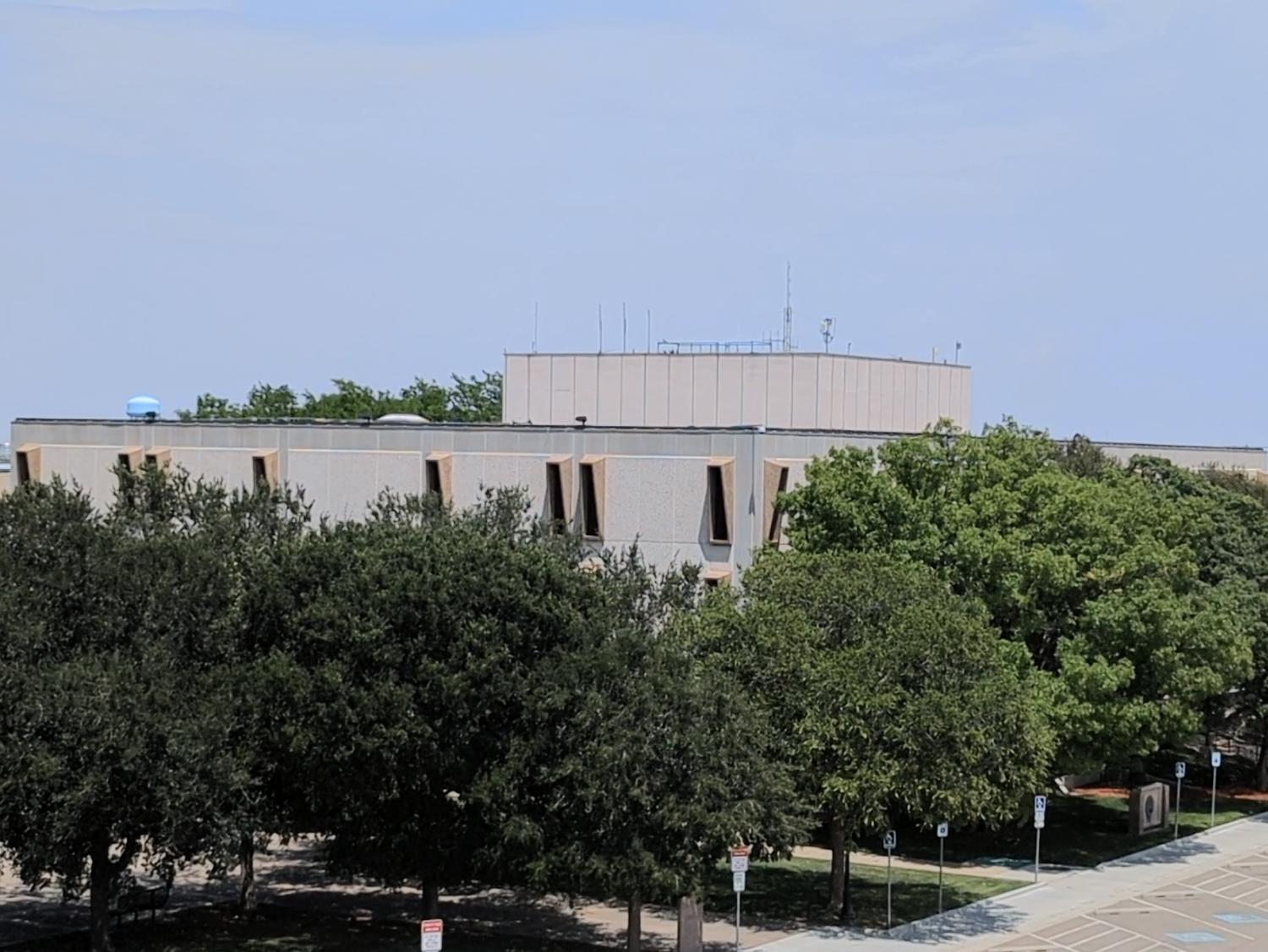
A photo showing the old Amarillo City Hall. The City of Amarillo is the largest governmental debtor in the city. Photo by Noah Dawson
By Nick Self
Figures released by the Texas Bond Review Board for the 2025-2026 fiscal year show the combined principal debt carried by local governments in the Amarillo area exceeds $1.27 billion, with total payments including interest approaching $1.78 billion if all obligations are paid on their current schedules.
The City of Amarillo holds the largest share. Its outstanding principal stands at $538,296,000. If paid according to the existing schedule, the city will pay an additional $190,421,903 in interest, bringing the total cost of the debt to $728,717,903.
Among the school districts, Amarillo ISD reports $204,900,000 in principal and $70,275,431 in interest for a total repayment of $275,175,431. Canyon ISD is close behind with $204,065,000 in principal, $61,473,585 in interest, and a total of $265,538,585. Highland Park ISD carries $107,720,000 in principal and $75,704,978 in interest, for a combined $183,424,978. Bushland ISD lists $87,655,000 in principal and $52,767,725 in interest, totaling $140,422,725. River Road ISD has a much smaller load of $5,470,000 in principal and $496,100 in interest, for a total of $5,966,100. Happy ISD reported no debt.
On the county side, Potter County shows $58,730,000 in principal and $26,778,738 in interest, for a total of $85,508,738. Randall County reports $44,870,000 in principal and $11,779,549 in interest, totaling $56,649,549.
The City of Canyon’s principal is $24,150,000, with $7,985,516 in interest and a total repayment of $32,135,516.
No debt was reported for the Village of Bishop Hills, the Village of Lake Tanglewood, the Panhandle Groundwater Conservation District, the High Plains Underground Water Conservation District, or the Amarillo Hospital District.
These totals reflect bonded indebtedness tracked by the Texas Bond Review Board and do not include other forms of long-term obligations that may exist outside the board’s reporting. The numbers provide a snapshot of the fixed costs local taxpayers will continue to support as principal and interest payments come due over the remaining life of the bonds.